
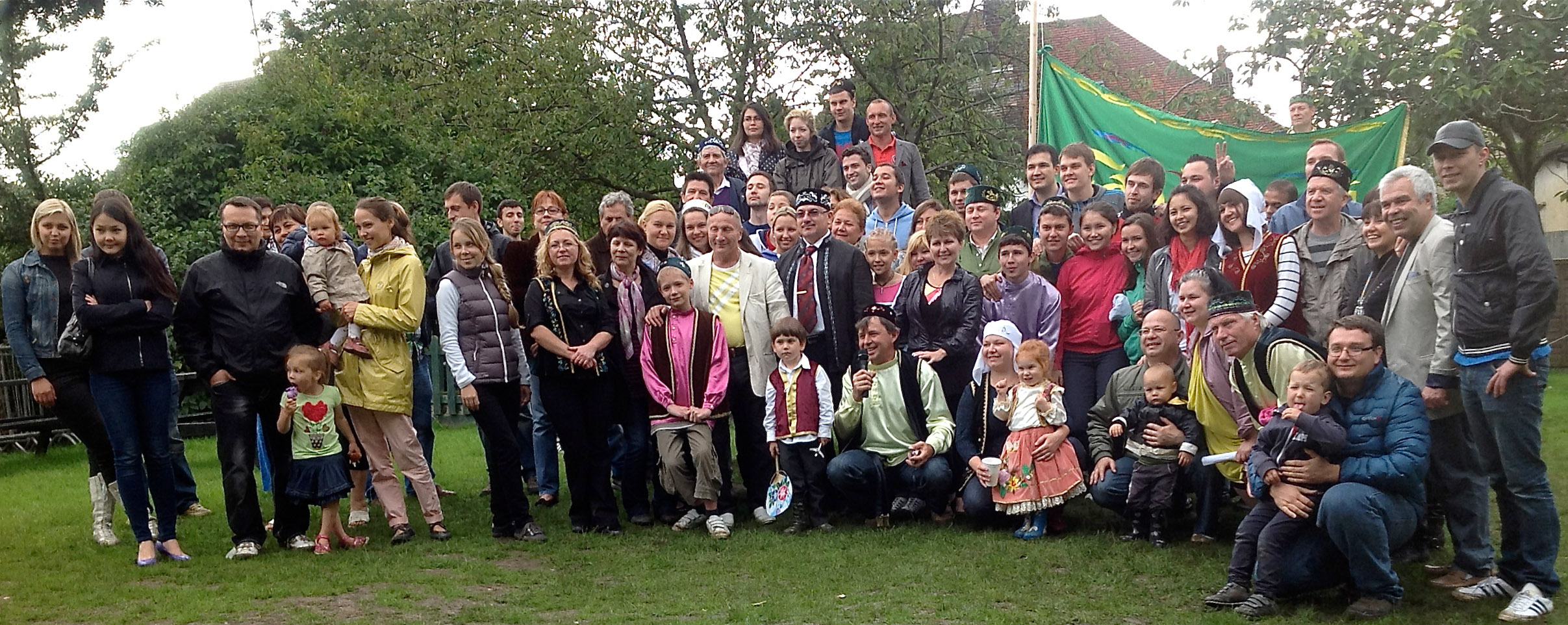

Sabantuy – the Plough Holiday – is an old Tatar tradition. Originally inhabitants of a settlement or several villages held it before spring sowing. In the twentieth century it became a tradition to hold Sabantuy after spring field works.
On the eve of Sabantuy youths on trimmed horses went around the village, gathering gifts for the winner of different contests and Sabantui games. Embroidered towels, table-cloths, kerchiefs were fastened to a special pole. This custom has been observed for centuries and is still alive. The festival is held in suitable meadows, forest clearings and nowadays even in the stadiums. Representatives of all nationalities of the region take part in it. It consists of various contests, games, singing and dancing, eating and drinking. In the course of time Sabantuy was enriched with different kinds of competitions. During these festivities you can watch volley-ball competitions, chess and draughts tournaments, table-tennis and weight-lifting contests. And the winners’ prizes are not limited only to embroidered towels. However, the main events of Sabantuy are still the national wrestling – kuresh – and horse-races. Sabantuy, rich in merriment and humour, is held nowadays nearly in all the regions of the planet where the Tatars live in large numbers. Everyone can be either a spectator or a participant of any contest.
  |

| Beating the Pot Placed on the common, is the pot, like a huge helmet, like the head of a giant or a djin, a hand size, it looks to us like it has a long beard moreover. Put the blindfold on my eyes, tight, my brother, there. Now wind it firmer, yes wind me up. Right, a bit more, I can do it. I’ve got a compass in my heart. Now I’ll coil the spring and let it go – watch out. Now give me the stick, but watch yourself lest you get hit on the head, I need mine more than others. Not much demand, my aim is more important. The pot is placed in the common like a huge helmet. At a distance it would seem very much like a giant’s head as in that fable about Ruslan. He circled and stood. Rocking and aiming, he paced. The beard waved as though the wind was combing it, and led him on. Te came out. You can’t turn back the old man. His hand rises higher and higher with each step. The grandfather goes on inexorably in the silence that suddenly arises… | Even if the stick falls past it’s the end for the pot. “I told you, you’d miss”, Sakhia laughed. “They’ll blindfold you, and I’ll look at you… Plash in the cup, but on it the tea, go on with you. Even if he misses he won’t let it go. There’s no such power in tea, whatever you say, what are you standing there for, come and watch the Sabantui. ”We went round the Sabantuy. From half a hundred leagues around the stalls had come together to trade. Everything that you have no time to attend to, can’t hasten to, is not in season: everything is here: hats with leather on top, body warmers on sale, which need felt trousers too. Young and old are measured. The sellers are terribly happy: all the goods get sold. It’s always so: it’s important to lay up a fur coat for the cold, as for summer – everyone is ready for it from when they were born. |

| Sack-Fight The mounted man is always better even on the coachbox than the one on foot. The old men have forgotten their years in the menacing “battle”. Instead of a cudgel the have a sack stuffed with straw. The rider beats with younger blows the old man in his declining years. The womenfolk have lined up in a row in tense anticipation, all hearts are merry at the prospect of the prize and fame. The mounted man is always better even on the coachbox than the one on foot. The old men have forgotten their years in the menacing “battle”. In the reckless duel he makes a not-full circle and bashes the older rider. The blow came swiftly. Grabbing the “horse” by the “neck” he stayed in the saddle. The “enemy” strove to repeat the blow and suffered terribly. | The old one turned nimbly, the cudgel went by, but by an unexpected blow he himself was torn from the saddle! The womenfolk tell about laughing and said through their tears: “They can hardly keep their hats on and they’re having a go at the riders.” “Well, thanks, uncle, that you pleased us with the talyanka!” “Everything I learned in the baths was self-taught and I’ve not forgotten it. The game’s the only thing for the young now. It’s too late now if you don’t know. But let anyone who knows sing along: “A girl kissed a lad, kissed him firmly on the lips…” The wife interrupts the grandpa: “Shame on your grey hair!” “What’s to be ashamed about?” Kharis says to his wife: “It was not me but the girl who kissed, why should I be ashamed?” |
 |
 |
| Spoon Race “What’s this miracle? Stones in spoons, a good match. The lads took the spoons in their mouths and run flat out.” “Where’s the surprise? Didn’t you see this before? Eggs in wooden spoons.” “Are they raw?” “Well, yes.” “What a strange affair – what’s the sense in that?” “What can I say to you?” “The sense, brother, is in the Koran, it’s useless if you’re dim-witted…” This is what our Sabantui is, joy and tears to people, but to the one who’s slow-witted…” who’s forgotten the ancestors’ customs, the songs, their native language, he won’t understand either this festival, or himself, or his people. I realised this a long time ago, to call oneself a man, you have to be one not just with your times but your people. You’ve come, look around, cry or laugh if it’s funny – perhaps slowly you’ll become what you should be. Ten young men,lads each with a spoon clenched in their teeth, put carefully, each an egg on their spoons. It’s not getting off the ground, this isn’t a race at all, the eggs bust, no one can take a step. The spectators fall about laughing at the entertainment. Some of them are beyond laughing and start to think. | Then someone bursts out laughing again, cry till you burst, but the Sabantui will show you the stern laws of life. We were getting ready to give our account of all this to auntie. Kharis himself aimlessly went off to look for her. He who hasn’t seen the sack race – well he’s not worth it. For another person – and I find it strange – indispensable success is most important. For this he’s even prepared to climb into a sack. His task is to win! I’m not like that. I think it’s very hard if it comes to that, to race in such happiness and joy. Now wrestling is worth watching. I’ll go and see it. No one will touch the samovar, get up Sakhia!We’ve valued real wrestling for a long time: two of us don’t share the one girl. Cocks fly at each other, not giving, not taking, the people gathered round, and she tries to separate them. Everyone laughs… Well, quite right, why not watch? Then, of course, the loser has to endure the mocking of the jokers. That’s normal, they crowd round and shout in their ears: “Cry oi, oi!” But as for me, when the desire comes to fight and beat someone, then it’s more noble to fight for a sheep than for someone. |